
Orthodontics moves teeth, but some bite problems come from the jaws themselves. When the upper and lower jaws don't line up because of how they grew, braces alone may not be enough to fix the bite.
Corrective jaw surgery, also called orthognathic surgery, repositions the jaws so the teeth can fit together properly. It is performed by an oral and maxillofacial surgeon, while your orthodontist uses braces before and after surgery to line up the teeth.
At Plymouth Orthodontics, we work closely with your surgeon so you have one clear plan from start to finish.
Your orthodontist and surgeon review records and create a shared plan.
Braces line up the teeth over several months so they will fit once the jaws are moved.
The surgeon repositions one or both jaws, usually in a hospital setting.
After healing, braces fine-tune the bite, followed by retainers.

Jaw surgery is usually done after growth is complete, often in the late teens or early twenties, so the jaws stay in their new position.
For younger children, guiding jaw growth early with Phase 1 treatment can sometimes correct a developing problem before it becomes severe. That's one more reason an orthodontic check-up by age 7 is so helpful.
Most patients spend a short time in the hospital, then recover at home with a soft diet. Swelling is normal and goes down gradually, and initial healing usually takes about six weeks. Many people return to school or work within a few weeks. Your surgeon will give you detailed instructions, and our team will be with you at every step.
Corrective jaw surgery, also called orthognathic surgery, repositions the upper jaw, lower jaw or both so they line up properly. It's used when the jaws themselves don't match, which braces alone can't fix. An oral and maxillofacial surgeon performs the surgery, and your orthodontist moves the teeth before and after.
Together, the two treatments improve chewing, speaking, breathing and facial balance.
Common signs include trouble biting or chewing, a large overbite or underbite, front teeth that don't touch, jaw pain or clicking, uneven tooth wear, difficulty closing the lips comfortably, or a face that looks unbalanced from the side.
An orthodontic exam with records and X-rays can tell whether the problem is in the teeth, the jaws, or both.
Often, yes. Many bite problems come from tooth position and can be corrected with braces, clear aligners, elastics or, in growing children, appliances that guide jaw growth. When the jaw bones themselves are significantly mismatched in an adult, though, braces can only disguise the problem, and surgery may give a healthier, more lasting result.
We'll explain which approach fits your situation.
Jaw surgery is usually done after growth is complete, which is often around ages 14 to 16 for girls and 17 to 21 for boys. Doing it after growth stops keeps the jaws from growing back out of position.
For younger patients, we may start treatment early and plan the surgery for later. Adults can have the surgery at any age.
Treatment happens in stages. First, braces line up the teeth over each jaw, which usually takes about 12 to 18 months. Next, the surgeon repositions the jaws. After healing, braces fine-tune the bite, and retainers protect the result.
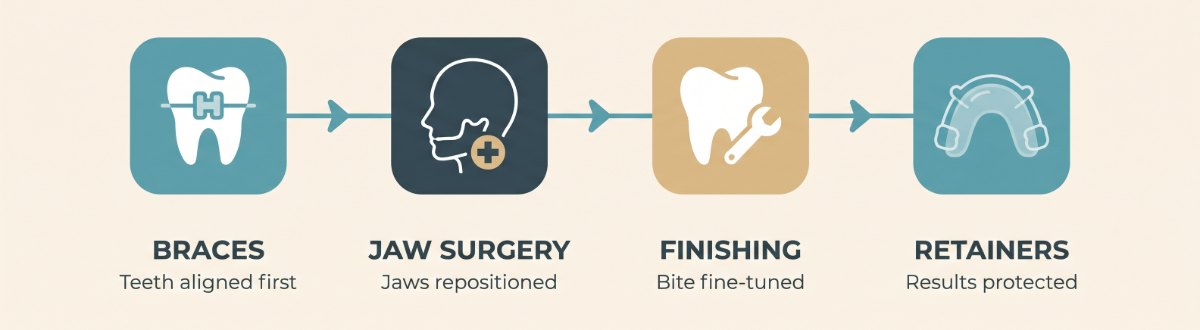
From start to finish, the whole process often takes about two years. We work closely with your surgeon at every step.
Initial healing usually takes about six weeks, with full bone healing in about 12 weeks. Most patients return to school or desk work within a few weeks and follow a soft-food diet for a while.
Your surgeon will give you detailed recovery instructions, and we'll resume orthodontic adjustments once you're ready.
Many medical insurance plans cover corrective jaw surgery when it's needed to fix a functional problem like trouble chewing, speaking or breathing. Coverage varies, so pre-approval is usually required. The orthodontic portion is billed separately through dental benefits.
Our team and the surgeon's office can help you understand your coverage before treatment begins.
For patients with a true jaw mismatch, many say it changed their life. Benefits can include easier chewing and speaking, less tooth wear, relief from jaw strain and a more balanced profile. It's a big decision, though, and it's always your choice.
We'll explain the pros, cons and alternatives clearly so you can decide what's right for you or your child.

The best way to learn what orthodontic treatment could do for you or your child is to schedule a complimentary initial exam. We will determine the best course of treatment and answer all your questions. Book your initial appointment online now using the link below, or just simply call our office.
Schedule Consultation